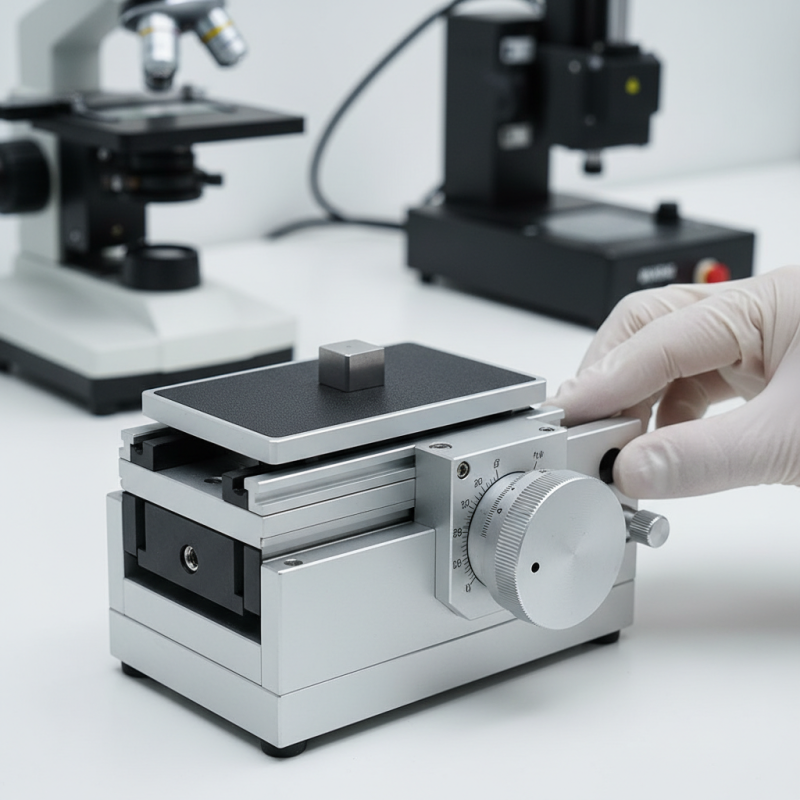
What is a Manual Linear Stage and How Does it Work?
A Manual Linear Stage is a versatile device widely used in precision positioning tasks. It serves crucial roles in laboratories and manufacturing. This stage allows users to move objects in a linear path with manual adjustments. The design typically includes a platform mounted on rails for smooth movement.
Using a Manual Linear Stage requires skill. Users must carefully apply their knowledge to achieve accurate placements. Too much force can lead to misalignment. Finding the right balance is essential for optimal use. The potential for error reminds us of the need for constant attention.
In various applications, precision is key. Whether in microscopy or CNC machines, the Manual Linear Stage plays an essential role. Miscalculations can result in flawed outcomes. Understanding its mechanics can enhance performance and mitigate risks in critical tasks.
What is a Manual Linear Stage?
A manual linear stage is a precision device used to position an object along a linear path. It features a rail system with a movable platform that can be adjusted by hand. These stages find applications in laboratories, manufacturing, and research. Their simplicity and direct control make them ideal for tasks requiring meticulous positioning.
Data from industry reports indicate a growing demand for linear positioning systems. The global market is projected to reach $5 billion by 2025. This reflects a rising trend in automation and robotics. However, manual linear stages often lack the speed and precision of their automated counterparts. While they are cost-effective, users must be cautious about potential human error in measurements.
Using a manual linear stage can be challenging. It requires steady hands and trained precision. The lack of advanced technology means that adjustments can be tedious. This limitation may hinder productivity in time-sensitive operations. Despite these issues, many professionals appreciate the hands-on control and mechanical simplicity they offer.
Components of a Manual Linear Stage
A manual linear stage is a precision mechanism used to move objects along a straight line. Understanding its components is crucial for effective use.
The primary component is the platform. This is where the object is mounted. It should be stable to prevent vibrations. Next, there are guide rails. They ensure the platform moves smoothly and accurately. The sliding mechanism often employs ball bearings, allowing for low-friction travel. Controls include knobs or levers. These can be fine-tuned for more precise adjustments.
Tips: Regularly check the guide rails for dust or debris. Even small particles can hinder performance. Clean them gently with a soft cloth.
Another vital part is the base. It provides stability to the entire stage. A sturdy base can help maintain alignment during movement. Sometimes, users overlook leveling the stage. An uneven surface can cause misalignment and frustration.
Tips: Use a level tool to ensure accuracy. A few moments spent on setup can save hours of work later. Always prioritize stability. It pays off in the long run.
Mechanism of Operation in Manual Linear Stages
A manual linear stage is a precision device often used in laboratory settings. It allows for smooth movement along a single axis. These stages are crucial for various applications, such as optics and microscopy. The simplicity of its design makes it accessible for users without extensive training.
The mechanism of operation is straightforward yet effective. Users can adjust the position manually by turning a knob or sliding a handle. This direct manipulation provides a tactile feel, essential when precise adjustments are needed. The movement is guided by linear bearings, ensuring low friction and high accuracy. However, the user must be careful; over-tightening can lead to jerky movements.
Manual linear stages often rely on a lead screw mechanism. This mechanism converts rotational motion into linear displacement. The lead screw's pitch determines how far the stage moves with each turn. While this design is effective, it does have its drawbacks. It might not provide the speed some applications require, leading to potential time inefficiencies during experiments. Users often need to balance speed and precision, which can be challenging.
Applications of Manual Linear Stages in Various Industries
Manual linear stages are versatile tools used across various industries. In manufacturing, these stages facilitate precise movements of machinery components. Operators can manually adjust positions with accuracy. This allows for assembly processes that require careful alignment. If adjustments aren't precise, it can lead to costly errors in production.
In the field of research, manual linear stages are critical in experiments. They enable scientists to position instruments or samples accurately. Microscopy and material testing often utilize these devices. Sometimes, the manual adjustment can be tedious. Researchers may find it challenging to achieve repeatability. Attention to detail is crucial here, but sometimes it can slip through the cracks.
The healthcare sector also benefits from manual linear stages. They are used in various medical devices, like calibration of imaging equipment. Accurate positioning ensures better diagnostics. However, the reliance on manual control means potential for human error. It’s essential to remain focused to ensure reliable results. With so many applications, manual linear stages play a vital role in many fields.
Advantages of Using Manual Linear Stages Over Automated Systems
Manual linear stages offer distinct advantages over their automated counterparts. One major benefit is cost-effectiveness. These stages are often more affordable. For labs with tight budgets, manual options provide a viable solution. Additionally, manual stages require less maintenance. Automated systems can have complex components. If something fails, repairs can be costly and time-consuming.
Control is another important aspect. Users can make precise adjustments with manual stages. This tactile feedback allows for fine-tuning. For some tasks, this level of control is essential. Automated systems may not always replicate the exact movements needed. However, this requires practice. Novice users may struggle initially, which can lead to frustration.
Finally, there's the aspect of simplicity. Manual linear stages have fewer parts and are straightforward to use. This makes them accessible for users of various skill levels. In contrast, automated systems can be daunting. Learning curves can be steep. This leads to errors and misalignments in critical applications. Nonetheless, one can appreciate the minimalistic design of these stages. They often allow for a clearer focus on the task at hand.
Comparison of Manual Linear Stages and Automated Systems